
Click HERE For
The Most Recent Exploring Finances Column
Levy County Commission
searches for a new attorney again
By Jeff M. Hardison © June 17, 2026 at 7:15 a.m.
All Copyrights Protected By Federal Civil Law
Do Not Copy and Paste to Social Media or Elsewhere
BRONSON – A seven page contract provided for approval from W.O. “Brett” Beauchamp, an attorney who serves as the undersheriff of Levy County right now, was included in a two-phase request from Levy County Manager Mary-Ellen Harper as one of the actionable items on the agenda of the regular twice-monthly meeting of the Levy County Board of County Commissioners on Tuesday (June 16).
More Below This Ad

Click On Ad To Go To Website
The County Commission has used a couple of law firms since firing without cause and without warning the previous county employee who was the county attorney.
Since the law firm of GrayRobinson has chosen against moving forward as the contractual attorney for the Levy County Commission, effective with the July 31 expiration of that service agreement’s term, Harper asked the County Commission to either approve a scope of work and direct staff to issue a request for proposal for legal services or authorize the chair to sign a contract with Beauchamp to serve as the county attorney, while authorizing GrayRobinson to transition those services to Beauchamp by July 31, or to take some other action.
Levy County Commission Chairman Tim Hodge made it clear that he was not going to endorse hiring Beauchamp without again seeking more requests for proposals, given that Beauchamp did not meet the deadline or requirements in a previous solicitation from the County Commission for individual attorneys or law firms to submit proposals to the County Commission.
During the discussion, one chronic complainer asked the commissioners why a law firm that temporarily agreed via contract to accept payments for legal services did not want to extend the contract. When she did not hear an answer, she said she intended to somehow find the answer via a request for public records, obviously being a novice at research into employment agreements between government agencies and law firms, as well as probably being unaware of finer points of Florida civil law and procedure.
Meanwhile, after more discussion the County Commission agreed that given the current law firm may be unwilling or unable to provide services after July 31, the county can find other firms to assist in that regard until either a new firm is selected as an independent contractor, or a person is chosen to serve as a county employee who is the county attorney.
County Commissioner Johnny Hiers said he did not want to feel pushed to choose Beauchamp because he did not see this ending of service by GrayRobinson as creating an emergency matter – where the county must make a hasty decision where there is only one candidate for the post. Hiers added that this is not a statement against Beauchamp but is instead just to note his rejection to feel forced into action immediately on this matter.
County Commissioner Desiree Mills said she concurs with Chairman Hodge and Commissioner Hiers about not seeing an urgent need to accept Beauchamp’s contract without first seeking other offers from applicants that may want to serve in the soon-to-be vacant (again) post. Mills said she believes there is enough time between June 16 and July 31 for the County Commission to solicit requests from individuals as well as from law firms to serve either as a county employee or as an independent contractor with the county as the County Commission’s attorney of record – and to make the choice.
Mills said that if Beauchamp proves to be the best candidate as the next county attorney, as may be decided by a majority vote of the County Commission, then that will be what happens. She noted, too, however, the caveat of this being the case only if he is still going to be interested in applying for the position after a new request for proposals is published.
One freelance journalist who is published on a social media platform told the County Commission that he thought the request for proposals should be published to the Florida Bar Association. Unfortunately, before that freelance journalist expressed his opinion at the lectern, he did not check with the Florida Bar Association. The Florida Bar Association does not accept requests for proposals for county attorney positions. County attorneys and assistant county attorneys are either hired as direct government employees or the county contracts with a private law firm, according to records.
The Florida Bar Association does not accept requests for proposals for county attorney positions because it is not a hiring body. It is the voluntary and mandatory regulatory association for lawyers in the state, while county attorneys are directly hired, appointed, or contracted by individual county governments (such as the County Commission), according to the Florida Bar.
The Florida Bar's purpose is to license, regulate, and discipline attorneys. It is not a government agency, nor is it the employer of local government lawyers. County attorney positions are filled directly by the specific county, according to the Florida Bar.
When a county in Florida has a vacancy for a county attorney, the position is typically filled via direct hiring or by using a dedicated search firm (such as the Florida Association of County Attorneys). Levy County has followed the best management practices that are established for hiring county attorneys, although there can be an argument made about whether the most recent termination of the previous county attorney by a 3-2 vote was the best choice back then.
After more discussion, including input from an attorney with GrayRobinson, Commissioner Mills made a motion to submit a request for proposals from individual attorneys as well as from law firms who seek to be either a county attorney that is a county employee or who want to serve as the firm that is an independent contractor with the Levy County Commission to provide certain legal services.
Levy County Commission Vice Chairman Charlie Kennedy seconded Mills’ motion, and the commission voted 5-0 to have County Manager Harper perform the actions required to publish the request for proposals where she has done so before. Given the direction to Harper, she understood that this will be posted to the places for individual attorneys to see it both within and without the current employment of any agency in Levy County, such as the Levy County Sheriff’s Office, as well as other places such as the Florida Association of County Attorneys.

Five Questions
That Could Change
How You See Retirement
Published June 15, 2026 at 11:30 a.m.
NEWBERRY -- Saving for retirement is important, but it’s only part of the picture. If you’re within five to 10 years of your target retirement date, it’s time to start thinking about what you actually want your retirement to look like. After all, getting to retirement isn’t the end goal — it’s what you want to do once you’re there that matters.
Start by asking yourself these five questions.
When do you want to retire? The age at which you retire matters more than you may realize. Retiring early sounds appealing, but it means saving more and having less time to do it. It can also create gaps in health care coverage and income before key benefits kick in. For example, Social Security benefits can begin at 62, but at a reduced amount. Full benefits are available between ages 66 and 67, depending on birth year, and waiting until 70 means the maximum benefit. Medicare doesn’t start until age 65, and penalty-free withdrawals from retirement accounts generally aren’t allowed until age 59½.
For couples, timing gets even more complicated. Staggering retirement dates can sometimes maximize benefits; in other cases, retiring at the same time works better.
A financial advisor can help you sort through these decisions and find the approach that makes the most sense for your situation.
How do you want to spend your time in retirement? Many new retirees are surprised to find that having unlimited free time feels disorienting rather than freeing. Thinking ahead about how to fill the days with meaningful activity – whether that’s travel, volunteering, pursuing hobbies or spending more time with family – can make the transition smoother.
It helps to sketch out what a typical week, month or even first year might look like. If there are big gaps, it’s worth thinking now about what might fill them in rewarding ways.
Where do you want to live as a retiree? Some retirees stay put, while others downsize or relocate entirely. Either way, it’s wise to consider whether a chosen location will work well as you get older, taking into account factors like proximity to family, access to health care, cost of living and climate.
What will your retirement lifestyle cost? It’s not uncommon for retirees to discover that their travel, entertainment or leisure expenses were higher than expected. The more active and involved you plan to be, the more you will likely need to budget.
Does your retirement involve giving back? Retirement often brings both the time and motivation to be more generous. Whether the goal is helping family members, donating to charity or volunteering in the community, it’s worth defining those goals and building them into an overall plan.
Now that your vision is taking shape, turn it into a plan. Work with your financial advisor to align your savings with the life you want — and revisit that plan as your priorities evolve so your retirement keeps pace with you.
Publisher’s Note: This article was written by Edward Jones for use by Edward Jones Financial Advisor Sheila K. Smith and Edward Jones Financial Advisor Ashlyn W. Burtle. Their office is located at 1845 S.W. 249th Drive, in CountryWay Town Square, Newberry. Phone 352-472-2776.
WGA Chamber of Commerce
gets new phone number
By Jeff M. Hardison © June 11, 2026 at 8 p.m.
All Copyrights Protected By Federal Civil Law
Do Not Copy and Paste to Social Media or Elsewhere
INGLIS – The Withlacoochee Gulf Area Chamber of Commerce, once known as the Inglis-Yankeetown Chamber of Commerce, changed its telephone number.
The new number is 352-453-9651. The Withlacoochee Gulf Area Chamber of Commerce is a nonprofit organization serving the twin “Old Florida” river communities of Inglis and Yankeetown in Levy County.
Originally incorporated in April of 1977, the chamber is dedicated to promoting local economic development, preserving the area’s natural environment, and boosting nature-based tourism along the Nature Coast.
The Chamber operates its visitor center out of 167 Levy County Road 40 (aka Highway 40) West in Inglis. Office hours are Friday 10 a.m. to 2 p.m.
The organization represents and promotes a diverse mixture of businesses, focusing heavily on eco-tourism, fishing guides, local seafood eateries, and small retail shops characteristic of the southern Levy County area. Other Chamber members include services, such as a multiple award-winning free daily news website that is 16 years old now.
The Chamber actively supports and promotes local traditions, such as the annual Seafood Festival by the Inglis-Yankeetown Lions Club in November, and the Christmas Parade as well as the Annual Yankeetown and Inglis Tour of the Towns.
The area is known for the Elvis Presley movie titled Follow That Dream, which was filmed in the Inglis-Yankeetown area of Levy County in 1961. In fact, part of CR 40 West is named “F0llow That Dream Parkway.”
Watermelon fest shows off park

The first members of First Baptist Church Men’s Group to show up for free watermelon carving and distribution duties are Travis Law (left) and Bob Jones. Free watermelons were again provided by Tillis Melons at the event hosted by the Chiefland Woman’s Club.
Story, Photos and Video By Jeff M. Hardison © June 7, 2026 at 5 p.m.
All Copyrights Protected By Federal Civil Law
Do Not Copy and Paste to Social Media or Elsewhere
CHEIFLAND – The 2026 Chiefland Watermelon Festival provided opportunities for fun that plenty of people enjoyed on Saturday (June 6).
There are four new metal benches in the park where the festival takes place nowadays. The festival has moved over the decades. It was once on Park Avenue East and down First Street South going to the historic Chiefland Train Depot.
More recently, it has become a mecca for vendors of food, art, crafts, charitable groups and more. The bandshell is a big hit, and this year Highway 19 of Otter Creek, which is comprised of musicians Everett Byrd, Lawson Byrd, Wiley Byrd, Abby Campbell and Coleman Campbell, were a strong force of musical entertainment. Amng their original songs performed on Saturday was Do they see Him in me?
Mayor Lewrissa Johns, one of the many members of the Chiefland Woman’s Club, was immensely helpful to the North Florida’s best journalist and publisher of a daily news website. She showed four of the six new watermelon artworks.
Another new feature this year was the Florida Department of State sending two huge trailers with bits of Florida history in them. The Mobile Museum Trailers are both customized and 80 feet long. The 160-feet of total trailer includes some artifacts from the Museum of Florida History, and some other items. The Museum of Florida History is located in downtown Tallahassee. It is housed on the ground floor of the R.A. Gray Building at 500 S. Bronough St. It is currently temporarily closed due to needed repairs.
Florida joined the Union on March 3, 1845. Florida officially seceded from the United States of America on Jan 10, 1861, and became one of the founding states of the Confederacy when it joined the newly formed Confederate States of America on Feb. 8, 1861. The Civil War ended and Florida became part of the nation again as it went through Reconstruction.
While slavery was abolished in Florida technically by President Abraham Lincoln’s Emancipation Proclamation in 1863, it wasn’t until May 20, 1865, that Emancipation was proclaimed aloud in Tallahassee.
Led by Gov. Ron DeSantis and Florida Secretary of State Cord Byrd, the 2026 statewide “Florida Freedom Tour,” is reportedly set to travel to all 67 counties, including Levy County.
As for being part of the whole 250-thing, Florida was under Spanish, French, and British control at different times in its colonial history – before the colonies separated from England. Those times are Spanish rule (1513–1763); French presence (1562–1565); and British rule (1763–1783).
Beyond the old history of Florida, the new history-making scene in the park for the 2026 Chiefland Watermelon Festival is noted below in photos and captions.
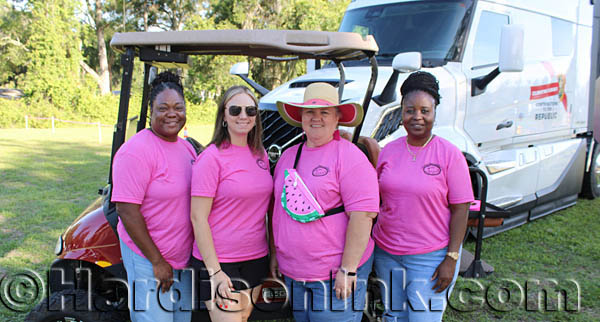
Among the many women who are members of the Chiefland Woman’s Club and who volunteered their time, treasure and talents on for this year’s watermelon festival are (from left) Maggie Latson, Mandy Waters, Tonya Townsend and LaWanda Jones.
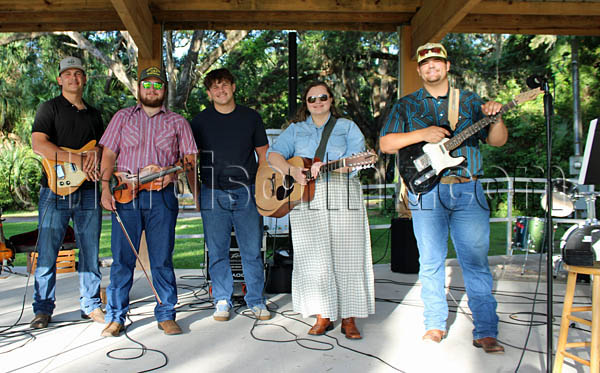
Showing up and performing at their first Chiefland Watermelon Festival concert are Highway 19 of Otter Creek. Seen here (from left) are Everett Byrd, Coleman Cambell, Wiley Byrd, Abby Campbell and Lawson Byrd.
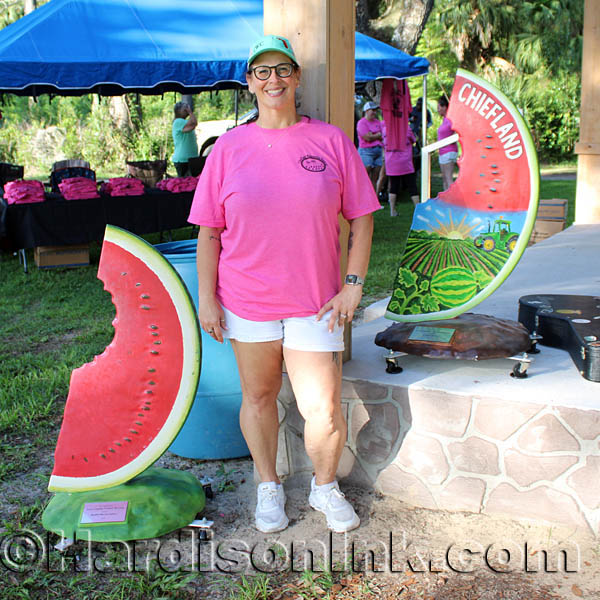
Chiefland Mayor Lewrissa Johns is seen with the two of the six new watermelon sculptures, with these by artists Keith Martin Johns and Claire Horne.
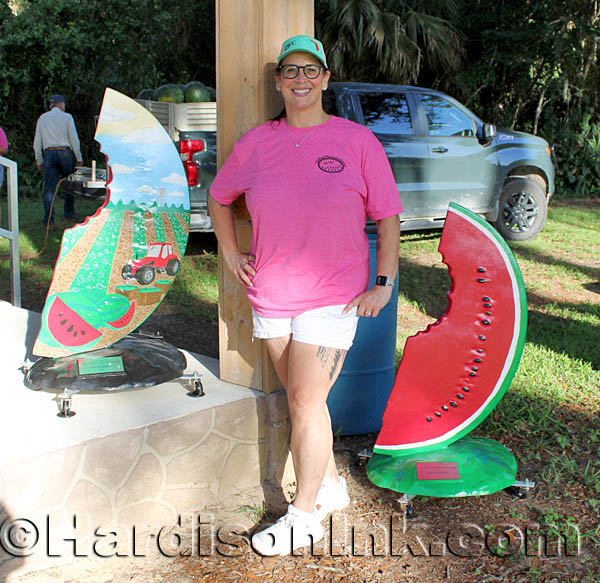
Chiefland Mayor Lewrissa Johns is seen with the two of the six new watermelon sculptures, with these by artists Jiannina Hudson and Aubrey Hudson. The two other scriptures are painted by artists Carolyn Cohens and Anne Talent.

Levy County Fire Rescue Paramedic Taylor Lartigua is seen in one of the smaller vehicles of the day.

One of the two 80-foot-long trailers with Florida history in it are seen here. The steps are relatively steep. For people who cannot climb them, the state provides an iPad to view the exhibit with narration.
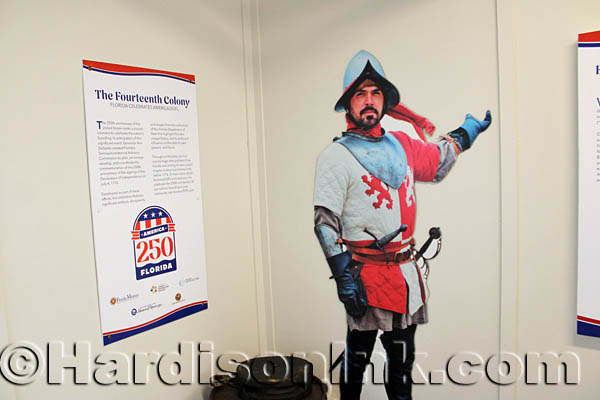
The Fourteenth Century and Florida are noted here in the trailer.

Artifacts included in this case include a gold cocoa tray (aka a mancerina) from the 1600s-1700s; a Spanish rapier or sword hilt (1715); a flintlock pistol (1751); a reproduction of a 1715 glass onion bottle; a reproduction of a 1652 silver ingot; and a reproduction of a gold puddle ingot. There are several other exhibits as well as a few paintings, too.
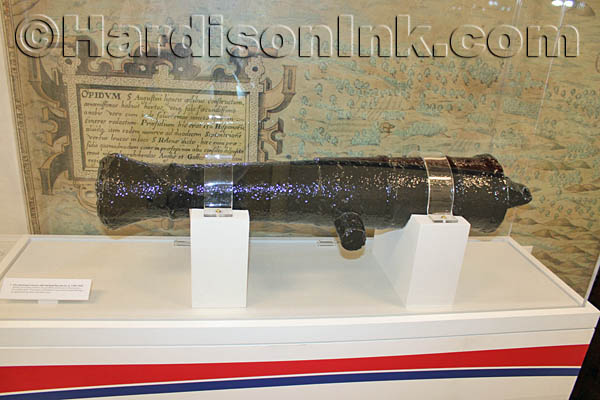
This is an iron swivel gun/cannon with a stamped fleur-de-lis on it, from the 1700s-1800s.

Among the printed pieces is this article related to the Civil War and Reconstruction in Florida.

Some more modern history shows a Tampa Tribune from 50 years ago with the headline – Man on The Moon, as well as some artifacts from other interesting aspects of the state’s history.

Florida continues making American history with its part in space exploration.
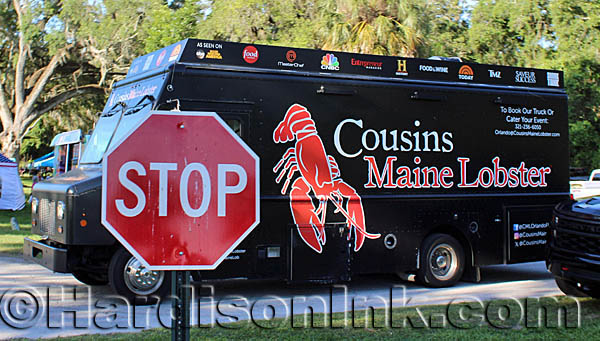
The Cousin’s Maine Lobster food truck arrives a bit after most of the other vendors. There was a wide variety of food and drink available this year.
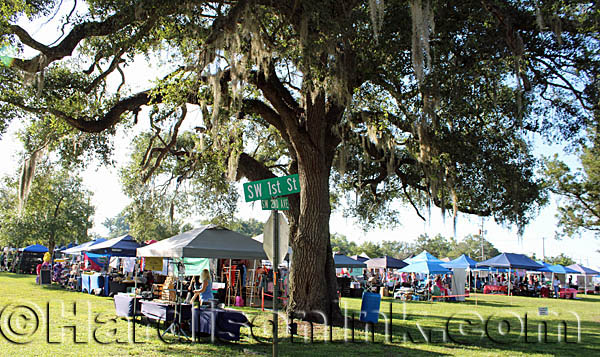
A big oak tree at one of the corners of the vendor area helps people remember the splendor of nature in rural Florida.

Face painting and henna tattoos were available, as were many other items.
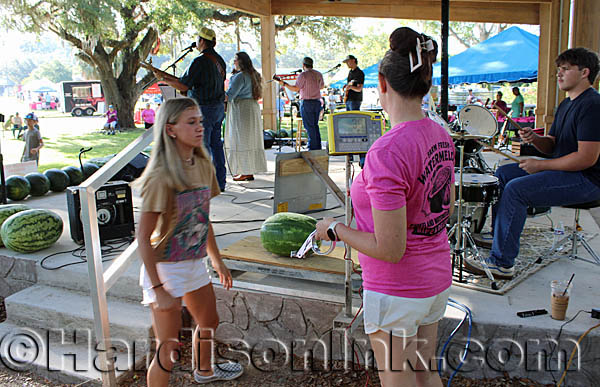
Among the team of people weighing in the watermelons that were entered for competition and that were auctioned Saturday night are Emily Sache, Sadie Sache and Kade Sache. The band was relatively loud for people weighing watermelons and for a journalist seeking answers about that process right then – so, there were other watermelon weighing team members that are not mentioned here,
Gilchrist County Commission
sees budget recap
County looks to buy 20 acres
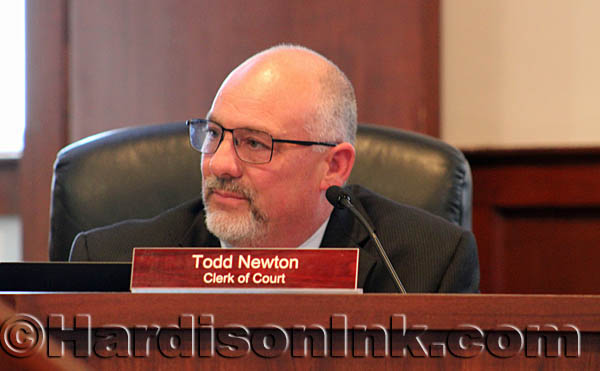
Gilchrist County Clerk of the Circuit Court and Comptroller Todd Newton speaks to the County Commission during the June 1 regular meeting.
Story and Photo By Jeff M. Hardison © June 3, 2026 at 7:30 p.m.
All Copyrights Protected By Federal Civil Law
Do Not Copy and Paste to Social Media or Elsewhere
TRENTON -- Gilchrist County Clerk of the Circuit Court and Comptroller Todd Newton provided the five members of the Gilchrist County Board of County Commissioners – Chairman Darrell Smith, Vice Chairman Bill Martin and commissioners Sharon A. Langford, Tommy Langford and Kenrick Thomas – with a budget recap from the first half of the fiscal year 2025-2026.
With almost all of the numbers from Oct. 1 through May 31, the MSTU-EMS part of the budget showed a 76 percentage of usage rather than 50 percent. That $3,26 million total budget showed there was about $2 million spent in the year to date, as of that report.
County Administrator Bobby Crosby explained how some emergency medical requirements led to overtime that had not been anticipated. He provided more details, including that not all medical calls can be split 50-50 with the fire department budget due to staff that are used for the different types of calls.
The recently created Otter Springs Fund of the budget shows $573,900 for this fiscal year. Year-to-date there was $246,758 spent, which is 43 percent. A mere $3,883 has come in so far on this park; however, it is anticipated to be a good revenue generator for the county – much like Hart Spring has become.
The Solid Waste Department, Newton said, is tracking along with budgeted funds for it.
The single issue of concern facing Gilchrist County and every county in Florida is how the local government can provide the same level of service when the voters of Florida may decimate the revenue stream provided from property taxes.
In its infinite wisdom, state leaders -- the lame duck governor who is leaving office after this term and the legislators sitting in office now -- are creating an option for voters to revise the Florida Constitution regarding property taxes.
The preliminary numbers Newton mentioned Monday, if voters chose to go with the governor and Legislature’s plan is $2.9 million less in the first year. Next year, the revenue loss will be about $4.5 million, Newton said.
As of the June 1 County Commission meeting, the exact numbers were not calculable because the leaders in Tallahassee were just then working on finer details.
As for funding the shortfall, “There’s a recommendation to create a grant program,” Newton said. “It says it will create a state trust fund” because the state leaders know counties cannot absorb the loss of revenue.
“However, it does not tell you what the funding source will be (for this alleged trust fund),” Newton said, or any other relevant information that is needed.
“So, to me,” Newton said, “I don’t know what we’re talking about (for the state trust fund).”
Somehow, the state “… will create something out of nothing,” he said.
As for this fiscal year in Gilchrist County so far, the funding is relatively on track so far overall.
OTHER ACTION
Among the other actions of the evening, the County Commission voted not to meet on June 15.
The next regular meeting will be July 6 starting at 4 p.m.
That July 6 meeting is when the commissioners will be given their starting budget books. There are budget meetings set for July 13 at 9 a.m.; July 14 at 5 p.m.; Aug. 3 at 2 p.m. with the regular meeting starting at 4 p.m. or as soon after the budget meeting as possible; and then there is a tentative final budget meeting set for Aug. 4 starting at 9 a.m. On Aug. 17 at the regular meeting, the final tentative budget will be ready if all goes as hoped, and the Aug. 24 deadline to have figures for the tax collector will be met.
In an item that was not on the agenda is for the county to let property owners know it is looking for at least 20 acres to buy to place the next solid waste transfer site.
Previous possible purchases fell through – mostly because the sellers backed out as a result of pressure from neighbors.
The Gilchrist County Board of County Commissioners is actively seeking to buy a minimum of 20 acres of available land for a future Solid Waste Transfer Facility.
The commission has published a call for properties that meet this requirement. If you own or know of available land, they request the following information to be submitted:
* Property address (if available);
* Parcel Identification Number (Parcel ID);
* Total acreage; and
* Contact information to reach the seller.
Submissions of offers to sell can be sent directly to the county via email at property@gilchrist.fl.us
Improved noise ordinance
approved at final reading
By Jeff M. Hardison © June 3, 2026 at 4:30 p.m.
All Copyrights Protected By Federal Civil Law
Do Not Copy and Paste to Social Media or Elsewhere
TRENTON – After some input from local residents, the Gilchrist County Board of County Commissioners voted 5-0 to adopt the amended noise ordinance. The essential changes are that noise is not allowed at any time rather than just certain times, and the revisions give the members of the Gilchrist County Sheriff’s Office more ability to enforce the law.
The amended law will go into effect when the Florida Secretary of State acknowledges receipt of the documents.
To ee the May 19 story about this change, click HERE.
Michelle Cannon appointed
to the FGC District Board of Trustees
Information Provided
By Governor’s Press Office
Published June 2, 2026 at 4 p.m.
TALLAHASSEE – On May 29, Gov. Ron DeSantis announced the appointment of Michelle Cannon to the Florida Gateway College District Board of Trustees.
Cannon is currently elected as the Dixie County Tax Collector, a position she has held since 2009. She is designated as a Certified Florida Collector through the Florida Department of Revenue. Cannon earned her bachelor’s degree from Saint Leo University.
This appointment is subject to confirmation by the Florida Senate.
Educator Wraps Up 31 Years As Of June 1
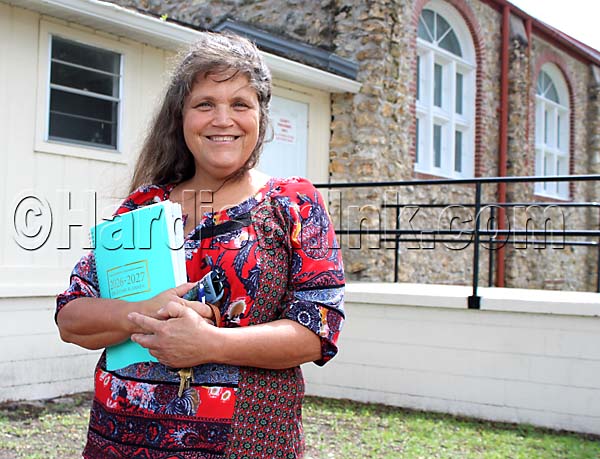
Gilchrist County Commissioner Sharon A. Langford is seen moments before entering the building for the June 1 regular twice-monthly County Commission meeting, and she is smiling. She just mentioned that very Monday heralded the end of her 31-year career in education within the Gilchrist County Public School District. During that time, she said, she taught fifth graders for 15 years and served as the truancy officer for 16 years. Langfored said she enjoyed her time in those roles. This is not retirement, though. She continues serving all of the people of Gilchrist County as a member of the County Commission. She agreed to a photo opportunity by HardisonInk.com just before taking action and continuing her work as a commissioner that very evening.
Photo By Jeff M. Hardison © June 2, 2026 at 7 p.m.
Finance director moves on
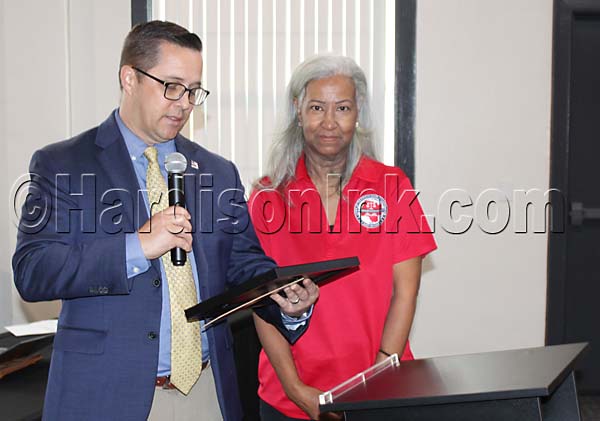
Outgoing Finance Manager Diana Sanchez listens as Levy County Clerk of the Circuit Court and Comptroller Matt Brooks reads the notation on a certificate of appreciation he presented to her.
Story and Photo By Jeff M. Hardison © June 2, 2026 at 7 p.m.
All Copyrights Protected By Federal Civil Law
Do Not Copy and Paste to Social Media or Elsewhere
BRONSON – Levy County Clerk’s Office Finance Manager Diana Sanchez is leaving her post to accept another position that affords her more time with her family, Levy County Clerk of the Circuit Court and Comptroller Matt Brooks announced Tuesday morning (June 2) during the regular twice-monthly meeting of the Levy County Board of County Commissioners.
Brooks said he is very happy for her as she begins in this next venture, adding that he wanted to publicly recognize her during the meeting.
Brooks presented her with a glass framed certificate of appreciation dated June 2 and signed by him. He read what was on the certificate of appreciation as well.
The certificate included specific information showing this certificate of appreciation is well deserved.
After noting it was presented to Diana Sanchez, it noted, “In recognition of your steady leadership, exemplary public service, and unwavering dedication to the stewardship of public funds in Levy County.
“Your commitment to accountability, fiscal responsibility, and the protection of the public trust has strengthened our work on behalf of the citizens of Levy County. Through your professionalism, integrity, and faithful service as Finance Director of the Levy County Clerk of the Circuit Court and Comptroller, you have set a standard of excellence worthy of special recognition,” the certificate noted.





Click On Ad To Visit Website.

Click On Ad To Visit Website.
Click On Ad To Visit Website.

Click On Ad To Visit Website.
Click On Ad To Visit Website.

Click On Ad To Visit Website.

Click On Ad To Visit Website.

Click On Ad To Go To Website.

Click On Ad To Go To Website.

Click On Ad To Visit Website.

Click On Ad To Visit Website.

Click On Ad To Go To Website.

Click on Ad to Visit Website.

Click Ad To Visit Website.


Click On Ad To Visit Website.


Click On Ad To Go To Website.

Click On Ad To Visit Website.

Click On Ad To Visit Website.

Click On Ad To Visit Website.

Click on Ad To Visit Website.

Click On Ad To Go To Website.

Click on Ad To Visit Website.

Please Click Above
To See Ad Rates And Reach.

Please Click On The Above Ad To Go To The Archived Stories And Photos.